The company has developed detailed logistical plans and tools to support effective vaccine transport, storage, and temperature monitoring. Sohini Das and Ruchika Chitravanshi report.
Each state has its own weak areas that need attention. Some states have already identified the gaps and sought the Centre's help. Vinay Umarji, Ishita Ayan Dutt, Samreen Ahmad and Sohini Das report.

The government plans to immunise 30 million people in the first phase, starting February, and by July, the target is to vaccinate 250 million people, reports Sohini Das.
The company has a pipeline of viral vaccines including Zika, dengue, varicella, as well as a potential Covid-19 inoculation.
'SII has started stockpiling the vaccine and now has roughly 40 million doses ready. It is using some of the capacities it had for under development products for the COVID-19 vaccine and by January we will have a capacity to make 100 million doses per month and a stockpile of 200 million doses.'
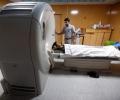
Siemens Healthineers, one of the largest manufacturers of made-in-India CT scanners, has sold 80-100 such machines in the last 45 days. The medical technology firm typically sells 250 machines in a year.

The first vaccine candidate will be an intra-muscular one, followed by intra-dermal and nasal ones, depending on test results.
Security breach came days after the firm got approval to conduct trials for Covid-19 vaccine candidate Sputnik V.
While there has been no commitment from the government on the procurement of vaccines, initial volumes, or distribution plans, there is a likelihood that the low interest loans may be made available to these players only when the time to scale up manufacturing arises.
Adjuvants may be added to a vaccine to produce more antibodies and longer lasting immunity thus minimising the dose of antigen needed.

In India, itolizumab, known by the brand name Alzumab, has been priced at Rs 8,000 per vial. Most patients require four vials for Covid-19 treatment, taking the cost of the therapy to Rs 32,000.
The Indian vaccine industry largely feels there are two ways in which vaccine innovation can be spurred - one, get a high price for the product and two, have the government buy a few hundred million doses of the product at a certain price.
A model being considered is to have a combined cold chain approach - where the agricultural cold chain would be combined with vaccine cold chains.
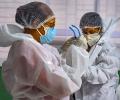
The bouquet of Covid-19 tests that most diagnostic labs are offering include antibody tests (blood tests), rapid antigen tests (point of care tests that detect the presence of an antigen from a nasal or throat swab in case of SARS-CoV-2), and reverse transcription-polymerase chain reaction (RT-PCR) tests.
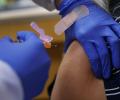
The global trials were halted after a study participant suffered a 'potentially unexplained illness, reports Sohini Das.

A gamechanger for offices and factories, Shycocan, claims to be able to clear an area of 1000 square feet from coronavirus.
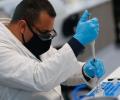
The Centre has also contacted five domestic and three multinational vaccine makers to understand how soon a candidate vaccine against Covid-19 will be ready.
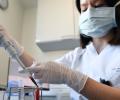
Many companies globally are working on plasma research to develop and manufacture hyperimmune globulin therapies from plasma donations.
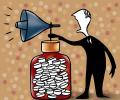
The online pharmacy market, which was worth about $512 million in 2018, is growing at a CAGR of 63 per cent and is expected to hit overall revenues of over $3.6 billion by 2022.
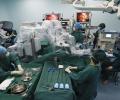
The National Digital Health Mission seeks to provide a unique health ID to each citizen who wishes to have one and also on-board the healthcare service provides - hospitals, pharmacies and diagnostic labs, among others. It will have an online database of doctors and personal health records.
 © 2026 Rediff.com - Advertise with us - Disclaimer - Privacy Policy - Sitemap - Feedback - About us - Terms of use - Grievances